Your next reading path
Books like The Hot Zone
24 connected reads, with a reason for every recommendation.

Start here
8 reading possibilities- 01

David Quammen traces how animal pathogens cross into human populations through investigative reporting that matches The Hot Zone’s scientific urgency.
- 02
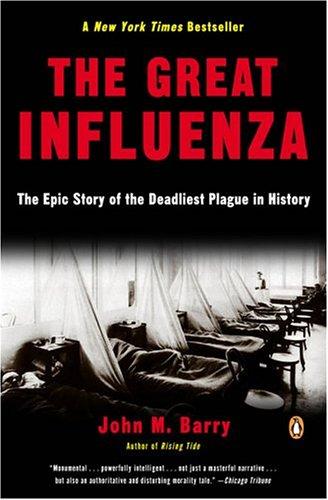
John M. Barry combines virology, public health, and human crisis in a detailed history of the 1918 influenza pandemic.
- 03

Laurie Garrett surveys emerging diseases and public-health failures with the same broad epidemiological perspective as The Hot Zone.
- 04
 An unexpected connection
Sy Montgomery’s intimate science writing about animal life bridges The Hot Zone’s primate focus to a more contemplative study of nonhuman intelligence.
- 05

Preston examines smallpox, laboratory research, and bioterrorism in another tightly paced nonfiction account of dangerous pathogens.
- 06

Mark Honigsbaum places major outbreaks across the modern era in a readable history of contagion, science, and social response.
- 07

Jonathan D. Quick explains how epidemics spread and how public-health systems can contain them, offering a policy-focused counterpart to The Hot Zone.
- 08
 An unexpected connection
Elizabeth Kolbert connects scientific investigation with global ecological danger, broadening The Hot Zone’s concern with biological threats.
Explore 16 more recommendations
- 09

John Kelly reconstructs the Black Death through disease history and eyewitness evidence, emphasizing contagion’s social consequences.
- 10

Steven Johnson turns a cholera outbreak into an investigation of transmission, mapping, and the origins of modern epidemiology.
- 11

Sonia Shah explores malaria’s biology, history, and worldwide impact with an accessible blend of scientific and social reporting.
- 12
 An unexpected connection
Rebecca Skloot explores the people, cells, and ethical questions behind biomedical research, offering a human-centered bridge from The Hot Zone’s laboratories.
- 13

Stephen Coss recounts Boston’s smallpox crisis through the collision of medical evidence, fear, and public controversy.
- 14

Meredith Wadman follows the scientific and ethical history behind a major vaccine, illuminating the human work behind disease prevention.
- 15

Seth Mnookin investigates vaccine fears and misinformation, extending The Hot Zone’s interest in how disease knowledge shapes public behavior.
- 16
 An unexpected connection
Lindsey Fitzharris recounts how nineteenth-century surgical reforms confronted infection and transformed medical practice.
- 17

D. T. Max explores inherited and infectious prion diseases through family history, laboratory science, and medical mystery.
- 18

Ed Regis examines biological weapons and pathogen research in a science-and-security narrative suited to readers of The Hot Zone.
- 19

Ken Alibek’s memoir describes Soviet biological-weapons research from an insider perspective, emphasizing laboratories and lethal pathogens.
- 20
 An unexpected connection
Candice Millard’s account of a perilous Amazon expedition bridges The Hot Zone’s tropical setting and physical danger to exploration history.
- 21

Michael Crichton’s scientific thriller imagines a team racing to understand and contain an alien microorganism.
- 22
Stephen King expands a lethal pandemic premise into a large-scale examination of survival, institutions, and human choice.
- 23

Frank Herbert uses a deliberately engineered plague to explore biological terror, politics, and social collapse.
- 24
 An unexpected connection
Roger Scruton offers a reflective counterpoint on humanity’s place in the natural world, extending The Hot Zone’s encounter with biological life beyond outbreak narrative.