Your next reading path
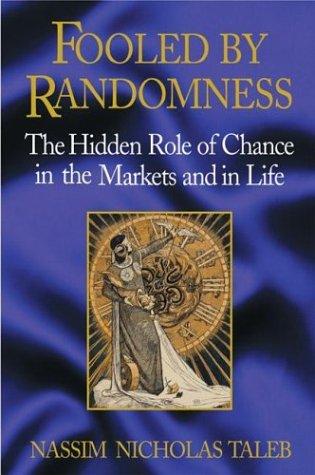
Books like Fooled by randomness
23 connected reads, with a reason for every recommendation.
Start here
8 reading possibilities- 01

Taleb extends his analysis of randomness into the rare, consequential events that conventional forecasting routinely overlooks.
- 02

Mlodinow explains how randomness influences outcomes that people commonly attribute to skill, intention, or merit.
- 03

Kahneman shows how cognitive biases distort judgments about probability, evidence, and success.
- 04
 An unexpected connection
Ishiguro explores how retrospective narratives can turn contingent choices and social forces into a comforting story of personal control.
- 05

Bernstein traces the intellectual history of risk and explains why measuring uncertainty transformed finance.
- 06

Silver explores why forecasts succeed or fail when noisy data and genuine signals are difficult to separate.
- 07

Lewis presents the Kahneman-Tversky research that revealed systematic errors in human reasoning under uncertainty.
- 08
 An unexpected connection
Kundera makes chance, recurrence, and the weight of arbitrary events central to a philosophical novel about human lives.
Explore 15 more recommendations
- 09

Spiegelhalter offers practical tools for interpreting data without mistaking statistical patterns for certainty.
- 10

Gigerenzer argues that understanding uncertainty requires usable statistical intuition rather than false precision.
- 11

Rosenzweig challenges simplistic explanations of corporate performance and exposes how hindsight creates convincing business stories.
- 12
 An unexpected connection
Mitchell links disparate lives across time to explore how unpredictable choices and systems shape apparently separate outcomes.
- 13

Tetlock identifies disciplined habits that help forecasters reason probabilistically without claiming certainty.
- 14

Dörner explains how people make poor decisions in complex systems by overlooking feedback, side effects, and changing conditions.
- 15
 An unexpected connection
Powers broadens the seed’s concern with complex systems by showing how human plans interact with slow, unpredictable ecological forces.
- 16

Thaler shows how predictable biases and choice architecture influence economic behavior and practical decisions.
- 17

Bogle offers a skeptical alternative to performance-chasing by emphasizing costs, diversification, and long-term discipline.
- 18

Malkiel questions the reliability of market prediction and compares active strategies with broad diversified investing.
- 19
 An unexpected connection
Le Guin uses an unfamiliar social world to test assumptions about identity, prediction, and the limits of confident interpretation.
- 20

Marks focuses on second-level thinking, uncertainty, and risk control rather than confident forecasts of market outcomes.
- 21

Housel shows how personal history, emotion, and luck shape financial decisions more powerfully than technical knowledge alone.
- 22

Ferguson provides a broad history of financial institutions, risk management, credit, and the social consequences of markets.
- 23

Page argues that multiple simple models can clarify complex problems better than reliance on one elegant explanation.